Database Security by Design: What Normalization Buys You Beyond Tidy Tables
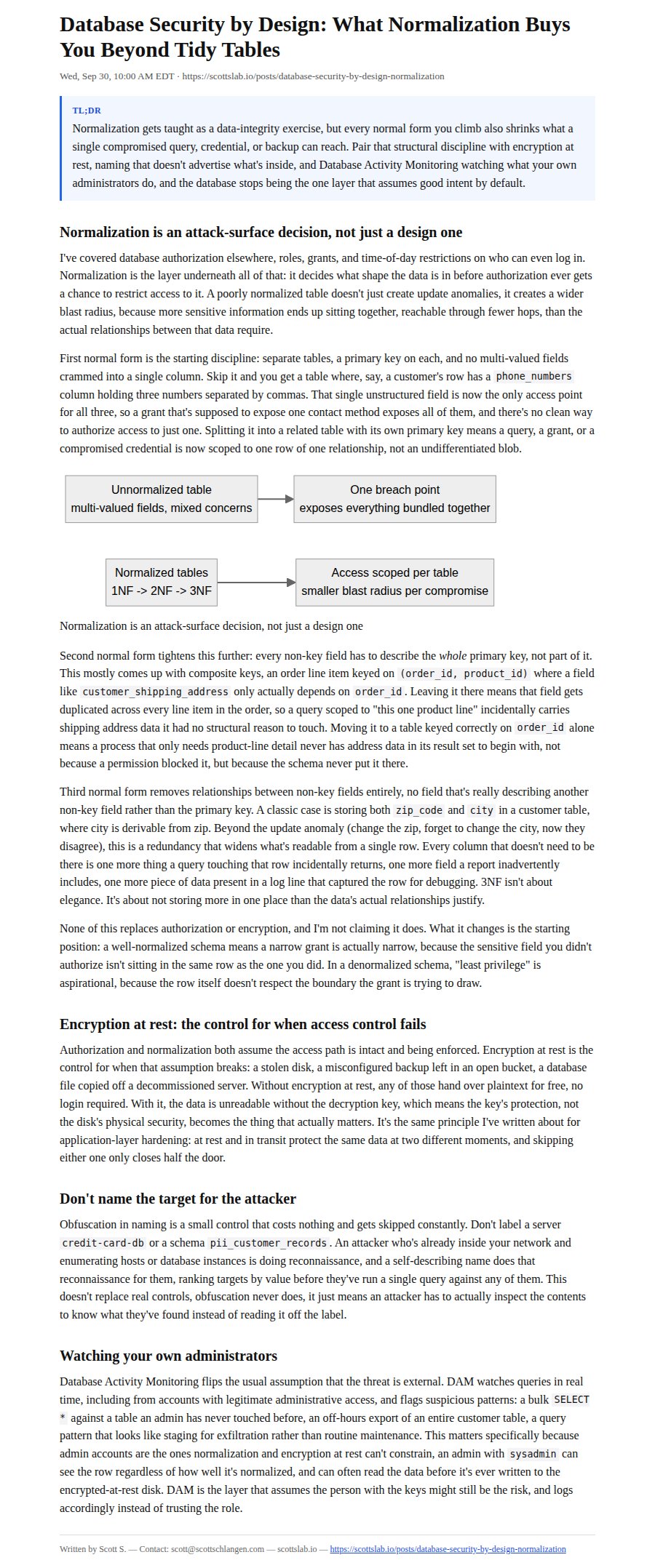
Normalization is an attack-surface decision, not just a design one
I've covered database authorization elsewhere, roles, grants, and time-of-day restrictions on who can even log in. Normalization is the layer underneath all of that: it decides what shape the data is in before authorization ever gets a chance to restrict access to it. A poorly normalized table doesn't just create update anomalies, it creates a wider blast radius, because more sensitive information ends up sitting together, reachable through fewer hops, than the actual relationships between that data require.
First normal form is the starting discipline: separate tables, a primary key on each, and no multi-valued fields crammed into a single column. Skip it and you get a table where, say, a customer's row has a phone_numbers column holding three numbers separated by commas. That single unstructured field is now the only access point for all three, so a grant that's supposed to expose one contact method exposes all of them, and there's no clean way to authorize access to just one. Splitting it into a related table with its own primary key means a query, a grant, or a compromised credential is now scoped to one row of one relationship, not an undifferentiated blob.
Second normal form tightens this further: every non-key field has to describe the whole primary key, not part of it. This mostly comes up with composite keys, an order line item keyed on (order_id, product_id) where a field like customer_shipping_address only actually depends on order_id. Leaving it there means that field gets duplicated across every line item in the order, so a query scoped to "this one product line" incidentally carries shipping address data it had no structural reason to touch. Moving it to a table keyed correctly on order_id alone means a process that only needs product-line detail never has address data in its result set to begin with, not because a permission blocked it, but because the schema never put it there.
Third normal form removes relationships between non-key fields entirely, no field that's really describing another non-key field rather than the primary key. A classic case is storing both zip_code and city in a customer table, where city is derivable from zip. Beyond the update anomaly (change the zip, forget to change the city, now they disagree), this is a redundancy that widens what's readable from a single row. Every column that doesn't need to be there is one more thing a query touching that row incidentally returns, one more field a report inadvertently includes, one more piece of data present in a log line that captured the row for debugging. 3NF isn't about elegance. It's about not storing more in one place than the data's actual relationships justify.
None of this replaces authorization or encryption, and I'm not claiming it does. What it changes is the starting position: a well-normalized schema means a narrow grant is actually narrow, because the sensitive field you didn't authorize isn't sitting in the same row as the one you did. In a denormalized schema, "least privilege" is aspirational, because the row itself doesn't respect the boundary the grant is trying to draw.
Encryption at rest: the control for when access control fails
Authorization and normalization both assume the access path is intact and being enforced. Encryption at rest is the control for when that assumption breaks: a stolen disk, a misconfigured backup left in an open bucket, a database file copied off a decommissioned server. Without encryption at rest, any of those hand over plaintext for free, no login required. With it, the data is unreadable without the decryption key, which means the key's protection, not the disk's physical security, becomes the thing that actually matters. It's the same principle I've written about for application-layer hardening: at rest and in transit protect the same data at two different moments, and skipping either one only closes half the door.
Don't name the target for the attacker
Obfuscation in naming is a small control that costs nothing and gets skipped constantly. Don't label a server credit-card-db or a schema pii_customer_records. An attacker who's already inside your network and enumerating hosts or database instances is doing reconnaissance, and a self-describing name does that reconnaissance for them, ranking targets by value before they've run a single query against any of them. This doesn't replace real controls, obfuscation never does, it just means an attacker has to actually inspect the contents to know what they've found instead of reading it off the label.
Watching your own administrators
Database Activity Monitoring flips the usual assumption that the threat is external. DAM watches queries in real time, including from accounts with legitimate administrative access, and flags suspicious patterns: a bulk SELECT * against a table an admin has never touched before, an off-hours export of an entire customer table, a query pattern that looks like staging for exfiltration rather than routine maintenance. This matters specifically because admin accounts are the ones normalization and encryption at rest can't constrain, an admin with sysadmin can see the row regardless of how well it's normalized, and can often read the data before it's ever written to the encrypted-at-rest disk. DAM is the layer that assumes the person with the keys might still be the risk, and logs accordingly instead of trusting the role.