KPIs vs. KRIs: Measuring the Program You Have and the Risk You're Taking
Security metrics come in two directions, and mixing them up is how leadership ends up reassured about the wrong thing.
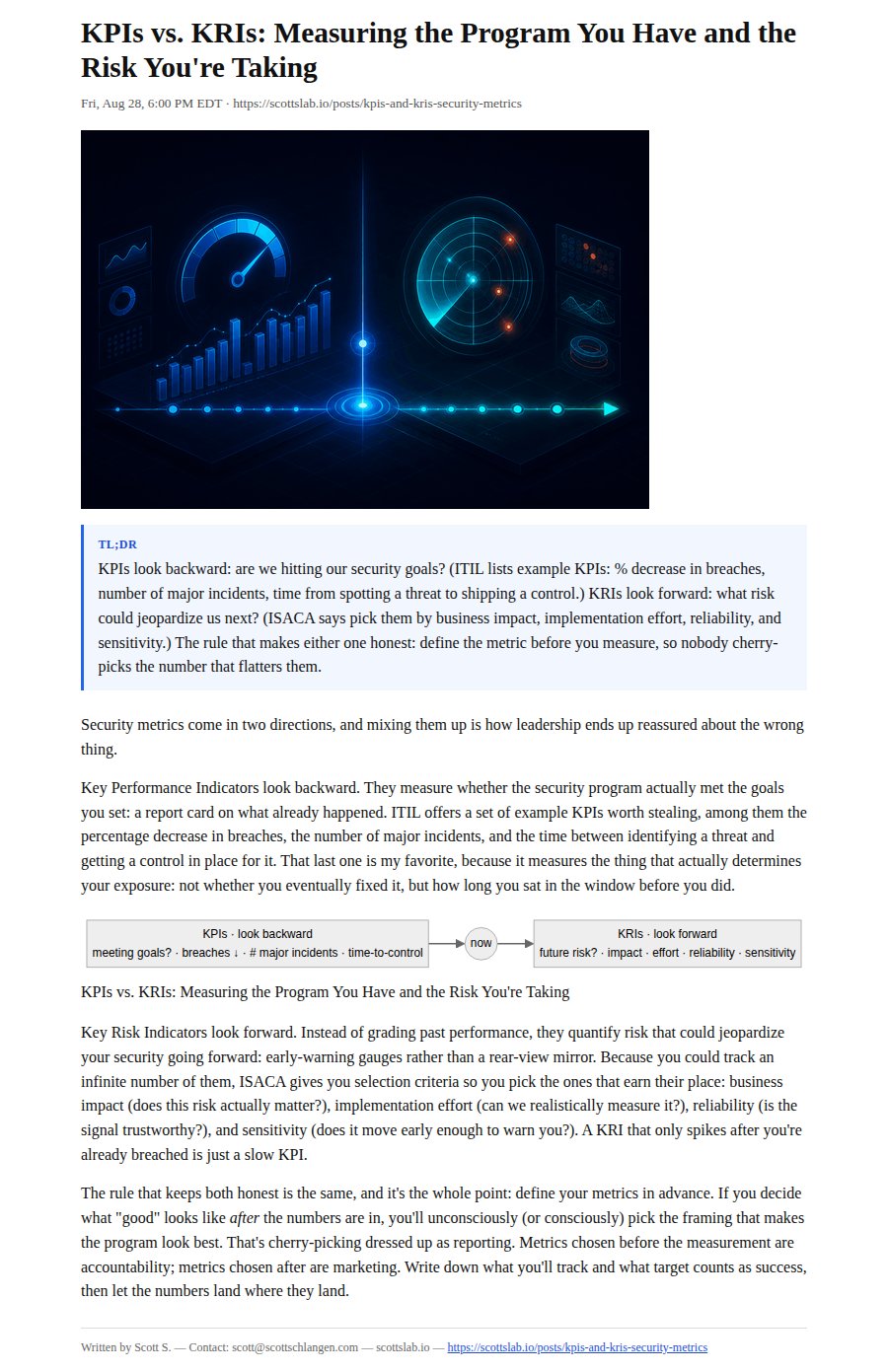
Key Performance Indicators look backward. They measure whether the security program actually met the goals you set: a report card on what already happened. ITIL offers a set of example KPIs worth stealing, among them the percentage decrease in breaches, the number of major incidents, and the time between identifying a threat and getting a control in place for it. That last one is my favorite, because it measures the thing that actually determines your exposure: not whether you eventually fixed it, but how long you sat in the window before you did.
Key Risk Indicators look forward. Instead of grading past performance, they quantify risk that could jeopardize your security going forward: early-warning gauges rather than a rear-view mirror. Because you could track an infinite number of them, ISACA gives you selection criteria so you pick the ones that earn their place: business impact (does this risk actually matter?), implementation effort (can we realistically measure it?), reliability (is the signal trustworthy?), and sensitivity (does it move early enough to warn you?). A KRI that only spikes after you're already breached is just a slow KPI.
The rule that keeps both honest is the same, and it's the whole point: define your metrics in advance. If you decide what "good" looks like after the numbers are in, you'll unconsciously (or consciously) pick the framing that makes the program look best. That's cherry-picking dressed up as reporting. Metrics chosen before the measurement are accountability; metrics chosen after are marketing. Write down what you'll track and what target counts as success, then let the numbers land where they land.